Start Where You Are
Book - $5Second edition - Part IV
Adjust When Life Changes
A useful change. A realistic start. Room to adjust.
Revise plans when conditions change, distinguish interruptions from conclusions, choose practical support, and find a responsible route back.
Get Part IV - $5Read the free sampleOpen experiment planner200 pages / 24 new chapters / $5 USD
Each volume is sold separately. Applicable taxes appear at checkout.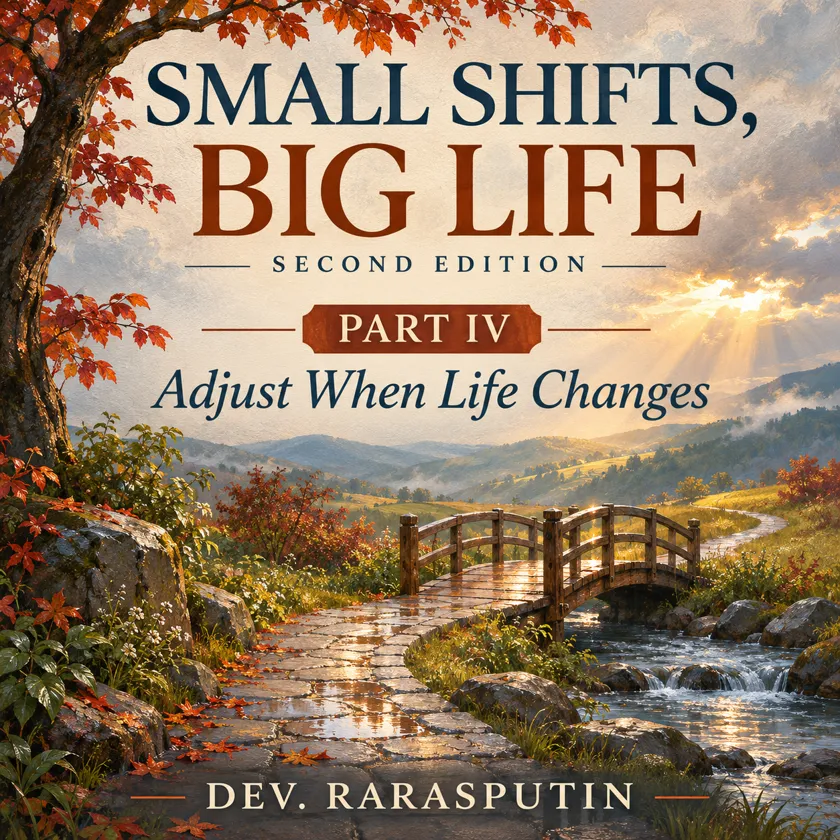
A fresh edition with room for your life.
New lessons, fictional examples, experiments, and usable phrases. You do not need the first edition. Each eight-page chapter moves through understanding, an example, observation, a small experiment, usable language, adaptation, review, and transfer.
The 200 pages include substantial guided writing space. This is a reflection workbook, not 200 pages of continuous prose or a video course. The PDF is not an interactive form.
Companion tool
Plan one useful experiment.
Use one ordinary situation. Keep the action small enough to describe, and choose a review point. No score or daily streak is required.
Entries are not sent to a server. Saving uses this browser's local storage; anyone using the same browser profile may be able to load them. Avoid private details on shared devices. Browser storage can be cleared; keep a download if you need a portable copy.
Inside Part IV
Twenty-four practical starting points.
01. Update the plan when conditions change
A plan is a response to conditions, not a promise that those conditions will remain fixed. Name what changed and which parts still apply. Keep any necessary obligations visible while revising optional details. Starting from the current situation can be more useful than repeatedly comparing it with the day you expected.
Try: Write the changed condition, the remaining requirement, and one revised action.
02. Separate an interruption from a conclusion
An interrupted attempt tells you something happened to the attempt. It does not by itself establish that the whole project is wrong or that you cannot continue. Describe the interruption and its practical effect first. Then decide whether to resume, revise, or reconsider the purpose.
Try: Describe one interruption without making a permanent prediction.
03. Choose the next controllable action
A difficult situation may include events you cannot directly influence. Identify one useful action available to you without implying that your effort controls the entire outcome. It may be obtaining information, updating someone, completing a small responsibility, or choosing a review point. Keeping the scope clear avoids false promises.
Try: List what is outside your control and one action you can responsibly take.
04. Make a temporary arrangement temporary
A short-term workaround can help during disruption, but it needs a review point and a clear purpose. Name what it is preserving and what it is leaving out. This makes it easier to end the workaround instead of allowing emergency compromises to become unnoticed permanent obligations.
Try: Write a temporary plan with a purpose and a review trigger.
05. Restart at the current level
After a break, the appropriate next step may be smaller or different from the previous one. Check what you remember, what has changed, and what is required now. You do not need to recreate every missed session before you can participate again. Use applicable instruction for tasks that require a formal return process.
Try: Choose a restart that reflects current information and capacity.
06. Name a disappointment precisely
A disappointment can involve a lost opportunity, an unmet expectation, or an extra burden. Naming the particular loss helps you decide what can be repaired and what must simply be acknowledged. You do not have to produce a positive interpretation before making the next practical choice.
Try: Write what you expected, what happened, and what is now missing.
07. Distinguish discomfort from missing information
Sometimes you are uncertain because an answer is unavailable; sometimes you know the next action but dislike doing it. Identify which situation you face. Seek the missing fact when it is relevant. When the action is clear, choose whether and how to take responsibility for it without waiting for a perfect mood.
Try: Write the unanswered question, or acknowledge that the necessary answer is already known.
08. Protect essentials during a busy period
During an unusually demanding period, distinguish essential responsibilities from optional improvement projects. Reduce the optional load and communicate any necessary changes. A basic arrangement can be appropriate for now without becoming a verdict on the rest of your life. Return to wider goals when there is a realistic opportunity.
Try: Choose the essentials, the optional pauses, and a date to reconsider them.
09. Ask for a defined kind of help
Help is easier to consider when the request is specific. Name the task, relevant timing, and what information the helper needs. Leave room for a smaller offer or a no. When the matter requires specialist expertise, identify the appropriate qualified source rather than treating any willing person as interchangeable.
Try: Write a small practical request that another person can understand.
10. Use a fallback that preserves the purpose
A fallback should solve the central problem under reduced conditions. It does not need to resemble the preferred method. Name the requirement before choosing the substitute. This lets you adapt a tool or location while preserving the part that genuinely matters.
Try: State a purpose and an available fallback that still serves it.
11. Review an error without inventing a cause
After a mistake, separate the event from your explanation. Check what you know, what remains uncertain, and who needs an update. You can repair a consequence before knowing every cause. Avoid treating one plausible story as established fact merely because it provides a neat explanation.
Try: Record the error, immediate repair, and one question for later review.
12. Make the repair fit the effect
A repair should address the actual consequence of a missed task or mistake. It may involve correcting information, replacing an item, rescheduling, or discussing a changed agreement. More effort is not automatically a better repair. Ask what would be useful rather than inventing a dramatic gesture that creates another burden.
Try: Match one consequence with a proportionate proposed repair.
13. Recognize a resource limit
A limit may involve time, money, access, tools, or the cooperation available. Name it concretely before deciding it is a personal failure. Consider whether it can be changed, worked around, or accepted for now. A plan that requires unavailable resources may need a different scope rather than stronger self-criticism.
Try: Describe one resource limit and two realistic responses.
14. Keep useful routines portable
A routine can depend unnecessarily on a particular room, object, or time. Identify its essential action and test a portable version when you expect travel or a changed schedule. Keep the version simple and appropriate to the setting. Some tasks genuinely need their original equipment and should wait.
Try: Choose one routine and separate its essential action from its usual setting.
15. Decide when to pause a project
A deliberate pause names why continuing does not fit, what must be preserved, and when or under what condition to reconsider. This is different from leaving a project in an ambiguous unfinished state. Tell affected people when the pause changes an agreement or dependency.
Try: Write a pause note with reason, preserved materials, affected people, and review trigger.
16. Avoid rebuilding everything after one setback
A disrupted attempt may need a targeted repair rather than a new system. Examine the point where the arrangement failed before replacing unrelated parts. A larger redesign may be justified, but it should answer a real problem. Keep the cost of rebuilding visible.
Try: Locate the specific failed step and test one repair.
17. Make comparison fairer
A comparison can omit different responsibilities, resources, timing, and unfinished work. Name what you cannot see before using someone else's result as a standard for your own plan. You can borrow a method while declining an unsuitable target. Compare the actual requirement as well as the visible output.
Try: Write the visible result and three relevant unknowns in one comparison.
18. Use a short update when plans slip
An update should explain the changed status, its effect on the other person, and the next realistic action. State uncertainty honestly. A timely partial update can be more useful than silence while you search for a perfect recovery plan. Avoid promises made only to reduce immediate discomfort.
Try: Write a factual delay update with one next decision.
19. Allow a different measure of progress
When conditions change, an old measure may no longer describe useful progress. Choose a measure that fits the current purpose. Completing a necessary handover or preserving a workable arrangement may matter more than the original output count. Keep the measure honest rather than changing it only to claim success.
Try: Write the current purpose and a measure that actually reflects it.
20. Identify what support actually helped
After receiving help or adapting a plan, name the specific feature that made a difference, if any. It may be practical information, a clearer agreement, or fewer setup steps. You do not need to invent a benefit. A precise observation can inform the next arrangement more than a general label such as support.
Try: Record the support offered, what changed, and what remained difficult.
21. Leave uncertainty visible
A workable plan may include information you cannot yet obtain. Name the uncertainty and choose what can responsibly proceed without it. Set a review trigger if new information would alter the decision. This is more honest than waiting for complete certainty or pretending uncertainty has disappeared.
Try: Write one provisional action and the condition that would require revision.
22. Re-enter a shared arrangement carefully
When returning after an absence or disruption, ask what has changed for the other people involved. Check current ownership, timing, and open issues before resuming an old role. You may need a brief handover rather than a total restart. Avoid assuming everyone else has kept the arrangement frozen.
Try: Request a short current-state handover before resuming a shared task.
23. Keep a lesson without keeping the whole ordeal
You may identify a practical lesson from a difficult period without preserving every detail or claiming the experience was necessary. Record only the information that supports a future choice. You can also decide that no lesson is clear yet. Reflection does not require gratitude for a setback.
Try: Write one optional practical lesson and one detail you do not need to keep reviewing.
24. Write a flexible return plan
A return plan can name an entry point, a small first action, relevant people to update, and a review condition. It does not need to restore the old pace immediately. Adapt it when the actual attempt reveals new information. The aim is responsible participation from the present situation.
Try: Write an entry action, a necessary update, and a point for reassessment.
Use only what helps.
What does the download include?
The full 200-page PDF and a companion ZIP with a chapter guide, phrase cards, practice-log CSV, and weekly review template. The free sample includes 12 selected pages.
Are these real case studies?
No. All named examples are fictional teaching situations. They illustrate choices without promising a particular outcome.
Must I complete every exercise?
No. Choose a relevant chapter and a proportionate practice. You can adapt, skip, or stop an exercise that does not fit.
How does this differ from the first edition?
This is a newly written five-volume sequence with fresh chapter lessons, examples, and exercises. It stands on its own. The first edition remains a separate product.
Five connected themes